
A Shrine for Self-Determination: Summoning Memory
New work up in Harlem at Long Gallery + some notes and insights on my practice

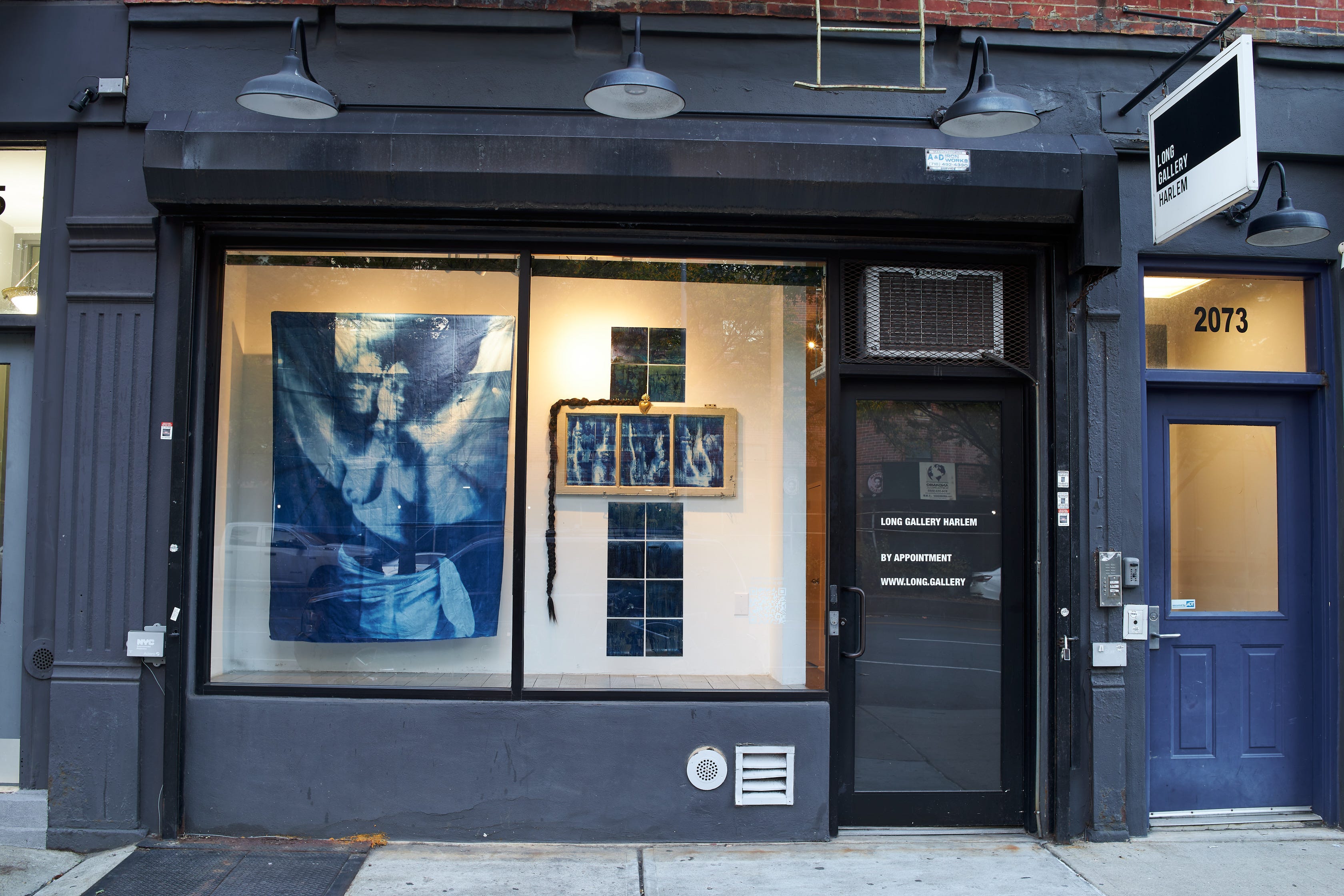
Praise Fuller, A Shrine for Self-Determination, 2025 (installation view at Long Gallery Harlem). Curated and Exhibition text by Sika Bonsu. Photography by Andrew Godreaux.
Over email, I wanted to share that I have a new piece of work that’s up for public viewing in Harlem at Long Gallery. Here’s a little bit about it, starting with the exhibition text.
Their Eyes Were Watching God (1937) posits love’s grammar as the soil where self-actualization takes root; A Shrine for Self-Determination (2025) consecrates that ground as a liturgy of becoming.
Praise Fuller traces her artistic origin back to writing stories by hand and doodling in church pews to stay awake during sermons. Beginnings marked by questions about who she might be beyond the constraints of family, faith, and social expectation. Alternative spaces built with friends offered the first visions of freedom. Like Janie Crawford, Hurston’s protagonist, who has her awakening to life and love underneath a pear tree, those moments for Fuller created a hunger for a life on her own terms. She carries those memories like talismans, cultivating a practice that strikes a balance between her inner world and community.
We can often read our inner questioning as turmoil and rush to avoid its discomfort. But in the same light, we must ask ourselves what or who our avoidance serves? What hidden truths do those questions reveal? A Shrine for Self-Determination asks for stillness so those questions can offer direction(s) toward collective freedom. Working in cyanotype and utilizing found objects and archival photographs of Southern sharecroppers, Fuller composes spectral portraits that summon our environments and name systems of oppression. A seraphic figure protects the altar and enshrines a resistance that survives beyond us, renewing itself in every generation– eternally.
Let Harlem’s legacies stand as living data, memory stitched through the fabric of time to meet us here. Here we are face-to-face with the horizon that Hurston names. Her emblem of a self-authored life is concrete on the blocks between 110th and 155th. These storefronts, art, and culture didn’t happen by chance; they were built by people who claim Janie’s revelation as their own. A Shrine for Self-Determination is a continual devotion to those journeys and wisdom gained through hardship.
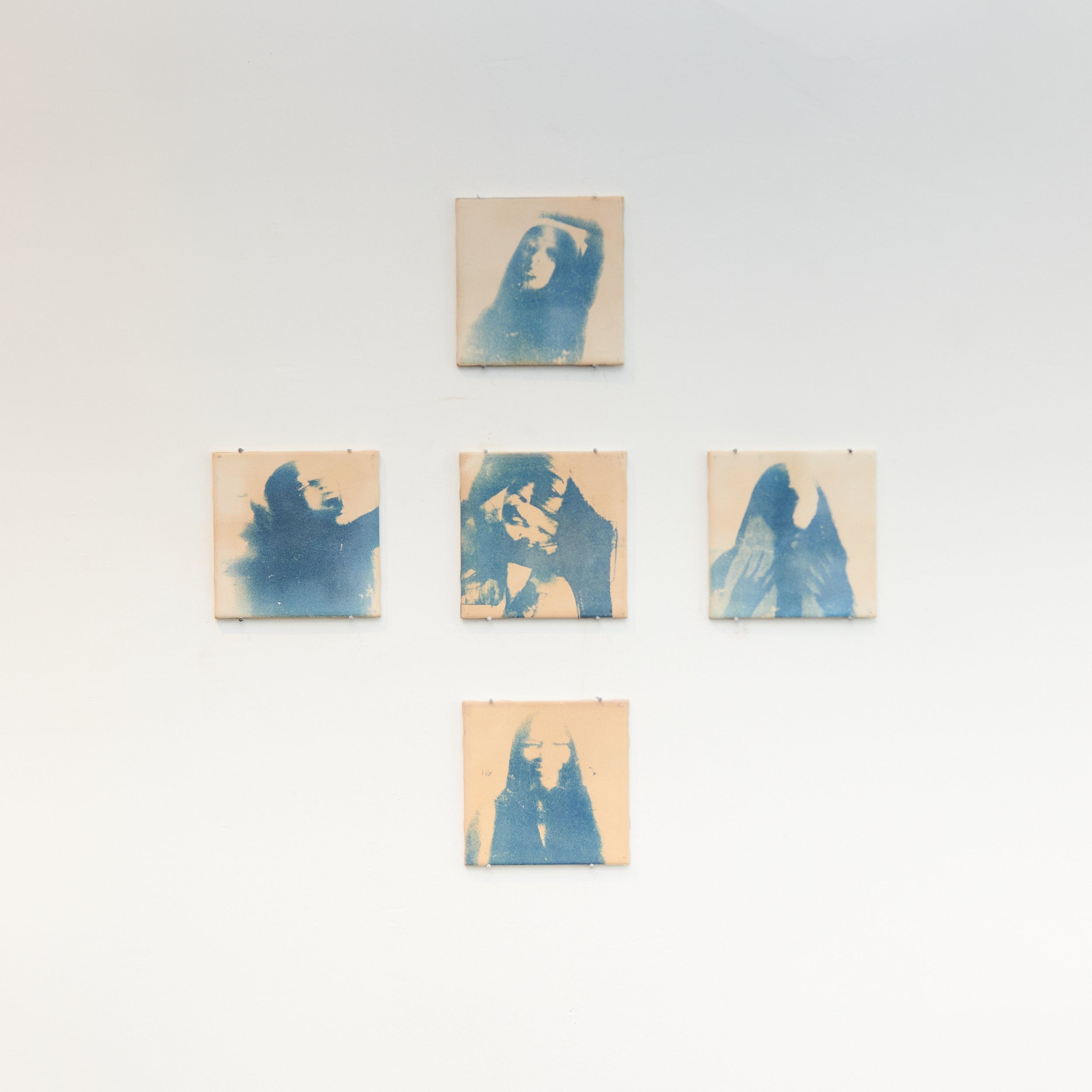
Peripheral prayers for my wellbeing, cyanotype on ceramic, 2024
My work tends to feature a lot of “self-portraits”, but they aren’t necessarily supposed to be me. I am simply the only model whose schedule I know and who understands my vision. In the future, as I hope you can gather from the biography I shared below, I hope to bring in more models to serve as my “spectral being”. I enjoy storytelling and creating characters in my head to use as motifs that guide my practice. Part of this is simply an evolution of being a lonely, sheltered, only child with too much spare time and an active participant in “fandom” culture. I would write fan fiction based on novels, TV shows, or movies I loved—inserting an original character usually loosely based on a part of myself I wasn’t frustrated with, or that had qualities I hoped one day would make their way into a sentence someone would use when describing me. As a visual artist, I take some of those seemingly silly or fantastical practices and bring out the truths in them. Fables became a way of communication, a way of myth-making, and a bridge to folklore.
She’s a spectral being that’s inspired by Southern Folklore and oral traditions that travels through memories and collects what has been lost to repression. Her presence serves as both a guardian and aid, a mirror showing us what we are actively and passively hiding from ourselves or each other.
As a spiritual archivist, she helps us understand the dialectics of the past and present. Through her, our memories congregate and materialize, making what was once private, collective. Her presence is spatial and mnemonic, inhabiting objects, land, and entire communities.
External influences may view our psyche as a subordinate to inscribe itself onto, causing pain and isolation. This spiritual archivist moves between the past and present, allowing us to prevail and create the future. This collector of memory is not a monolithic spirit, but exists as a plurality, making herself/itself known in everything we experience. Perhaps the times we are in a confused state of opposing feelings, like wretchedness and belief, she was summoned to clarify and reveal who and what needs care.
I have been thinking a lot about the “Southern Gothic” genre, and how its elements helped me build this narrative and create intention behind my work.
Southern Gothic:
Definition:
A literary style that uses Gothic elements to explore the dark, flawed, and often repressed aspects of Southern culture and history.
Themes:
Decay, grotesque characters, supernatural occurrences, religious guilt, racial tensions, dysfunctional families, and the lingering impact of the past.
Setting:
The American South, often featuring dilapidated plantations, decaying mansions, and other isolated or decaying locales.
Key Authors:
Flannery O’Connor, William Faulkner, Tennessee Williams, Truman Capote, Carson McCullers, Zora Neale Hurston, Alice Walker, and Toni Morrison
I never want my work to be self-serving or a display of my individual experience. If I were to draw from my personal experiences, which every artist should in some capacity, I wanted to present it in a way that creates space for me to then hold onto someone else’s. My definition of “collective memory” is borrowed from Toni Morrison’s concept of “rememory,” which reflects how memory exists beyond, or even escapes, the individual mind by inhabiting objects, places, and communities. To me, it’s not just about recalling an event or period in time— “getting the facts straight”; it’s about the materiality of the past in the present. Reading Beloved has heavily inspired me because of the way Morrison presents the perspectives of the formerly enslaved through heartbreaking memory recounts, some of which become spatially evoked through the central setting of 124. I’ve been revisiting some Fanon as I discover how colonialism ties into all of this, how the external/material (colonialists/imperialists) influence the internal (psyche/spirit). Speaking about the “material” as a precursor to “spirituality” through a fictitious ghostly being that can possess the physical world and people to become tokens of memory is what I hope can be drawn from my work.
“In the world through which I travel, I am endlessly creating myself.” — Black Skin, White Masks
“The colonized man liberates himself in and through violence.” — The Wretched of the Earth
“I came into the world imbued with the will to find a meaning in things, my spirit filled with the desire to attain the source of the world, and then I found that I was an object in the midst of other objects.” - Black Skin, White Masks
“The white gaze, the only valid one, is already dissecting me. I am fixed.” - Black Skin, White Masks
“In the white world, the man of color encounters difficulties in the development of his bodily schema. Consciousness of the body is solely a negating activity.” - Black Skin, White Masks
“I was responsible at the same time for my body, for my race, for my ancestors.” - Black Skin, White Masks
“Superiority? Inferiority? Why not simply try to touch the other, feel the other, discover each other?” - Black Skin, White Masks
“I am not a prisoner of history. I should not seek there for the meaning of my destiny. I must constantly remind myself that the real leap consists in introducing invention into existence.” - Black Skin, White Masks
“Some things you forget. Other things you never do. But it’s not. Places, places are still there. If a house burns down, it’s gone, but the place—the picture of it—stays.” — Beloved
Anyway, that’s all for now. I would love to know your thoughts. And let me know if you catch the installation.
xoxo
Praise (if there are any typos, know that editing is always seen as optional to someone like me, aka just another girl posting on Substack)
Your work looks really great. Congratulations, Praise.